Johns Hopkins University
The Johns Hopkins University, or Hopkins for short, was founded in 1876 as the nation's first research university and is a world-renowned private university that is among the top universities in the world. The University's main campus is located in Baltimore, Maryland, and its branch campuses are located in Washington, D.C., about one mile from the White House, as well as teaching campuses in Nanjing, China, Bologna, Italy, and Singapore.
General Information
The Johns Hopkins University, also known as Hopkins University (JHU), is one of the world's leading private universities, located in
Baltimore, Maryland, USA. Hopkins is particularly known worldwide for its excellence in medicine, public health, economic studies, international relations, literature, the arts, and numerous areas of applied scientific research. Thirty-seven of the university's alumni have been awarded the Nobel Prize. According to the National Science Foundation, Johns Hopkins received more than $1.5 billion in research funding from the National Science Foundation, the National Institutes of Health, the National Aeronautics and Space Administration, and the U.S. Department of Defense in fiscal year 2007, making it the nation's highest annual research funding university for 30 consecutive years. As of 2008, 130 members of the National Academies of Sciences, Engineering, Medicine, and Arts and Sciences were enrolled at Johns Hopkins. As of 2005, eight Johns Hopkins researchers have received the National Medal of Science.
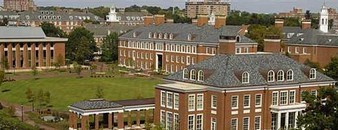
Johns Hopkins is also one of the 14 founding schools of the Association of American Universities (AAU). In addition to Baltimore, the university also has full-time teaching and research facilities in other parts of Maryland, Washington, D.C., Italy, Singapore, and China. Johns Hopkins began as the first modern research university in the United States, and its success sparked the transformation of American universities into research universities and the establishment of a number of new research universities. Johns Hopkins is also home to the ground control centers for the Hubble Space Telescope and the James Webb Space Telescope. With 4,744 undergraduate students and 14,275 graduate students, and a faculty of 3,100, Johns Hopkins has a student-to-faculty ratio of 1:6, making it one of the world's leading institutions of higher learning.
Hopkins' iconic Gilman Hall When John Hopkins, a Baltimore, Maryland, banker and Quaker, died in 1873, he left a large estate worth $7 million (equivalent to $1.6 billion in 2006 in purchasing power). In 1875, the trustees of his estate purchased the first parcel of land on Howard Street in downtown Baltimore as the future campus of the university, and on January 22, 1876, Johns Hopkins University was officially founded.
Hopkins was the nation's first research university with the goal of "encouraging research and the advancement of independent scholars so that they may, through their superb learning, move forward the science they pursue and the society in which they live." Hopkins' founders wanted to leave behind the old stereotypes of the American Academy and create a new type of research university focused on expanding knowledge, graduate education, and encouraging a research ethos. Modeled after the German university model advocated by Wilhelm Humboldt and others and represented by the Humboldt University of Berlin, Johns Hopkins was the first university in the United States to teach in discussion classes and to admit undergraduates in separate majors, and its philosophy and model had a tremendous impact on and were emulated by later American universities, such as the University of Chicago. The university's Latin motto is Veritas vos liberabit (The truth will set you free, from the Bible, John 8:32). The university's coat of arms features the family coat of arms of the founding fathers of Maryland, the Lords of Baltimore, supported by an oak branch in the center, with books and a globe symbolizing the arts and scientific research. The first president of Hopkins University was Daniel Gilman.
Majors
Undergraduate majors: Business Administration, Finance and Economics, Architecture, Chemical Engineering, Economics, Education, Electrical Engineering, Computer Science, Archaeology, Biochemistry, Anthropology and Geography, Theology, Law, Fine Arts, Modern History, Human Language Production Studies, Natural Sciences, Psychological Studies, Mathematics and Computing, Engineering, Social Sciences, Mathematics, Biological Sciences, Clinical Medicine, Management, Physics, Music, Philosophy, and political science, etc. [1]
Graduate Studies: Business Administration, Finance and Economics, Architecture, Chemical Engineering, Economics, Education, Electrical Engineering, Computer Science, Archaeology, Biochemistry, Theology, Law, Fine Arts, Modern History, Human Language Production Studies, Natural Sciences, Psychological Studies, Mathematics and Computing, Engineering, Social Sciences, Mathematics, Biological Sciences, Clinical Medicine, Management, Physics, Music, Philosophy, Political Science, etc.
Honors Rankings
According to the Times Higher Education Supplement (THES), Hopkins was ranked 9th (nationally) and 13th (globally) overall in 2008. In the latest 2011 U.S. News and World Report rankings of the nation's best universities, Hopkins is ranked 13th among "National Universities".
The fields of medicine and public health have traditionally been strong points at Hopkins. The Hopkins School of Medicine is on par with Harvard Medical School. The Bloomberg School of Public Health has been ranked number one in the nation for years. The Times Higher Education Supplement ranks Hopkins third in the world in biomedical and life sciences. Hopkins is the largest recipient of U.S. federal grants and National Institutes of Health (NIH) research funding. As the teaching and research hospital of the Hopkins School of Medicine, Johns Hopkins Hospital has been ranked among the nation's best hospitals for 20 consecutive years.
Hopkins also excels in other disciplines. The school's graduate programs in biology, biomedical sciences, biomedical engineering, electrical engineering, environmental engineering, human development, family studies, health sciences, humanities, physics, mathematical sciences, and international affairs are all ranked among the top 10 in the nation.
Between 1999 and 2009, Hopkins ranked third in the world for citations, an important indicator of research effectiveness, behind Harvard University and the Planck Institute in Germany, a consortium of more than 80 research institutions.
Hopkins' Peabody College (the Department of Music) is one of the top three music schools in the country.
National University Rankings
U.S. News and World Report (U.S. News).
2022U.S. News Ranking of America's Best Colleges No. 9 [19]
2021U.S. News Ranking of America's Best Colleges #9 [21]
2020 U.S. News Ranking of America's Best Colleges #10 [7]
Forbes (Forbes).
2019 Forbes U.S. College Rankings #22 [8]
Global University Rankings
U.S. News:
No. 9 in 2022 U.S. News World University Rankings [16]
2021 U.S. News World University Rankings #10 [22]
2020 U.S. News World University Rankings #11 [2]
In October 2014, Hopkins was ranked 11th in the world and 9th in the U.S. in the 2015 Global University Rankings, released for the first time by U.S. News and World Report (U.S. News) in conjunction with Thomson Reuters Group in the U.K.
Application Requirements
Undergraduate: SAT Verbal 632, Math 707, overseas students must have TOEFL 560.
Graduate students: TOEFL scores, GRE/GMAT scores, GPA 3.8 or higher
Johns Hopkins University Fees at a Glance.
Application processing fee: $50
Tuition at Johns Hopkins University: Undergraduate: approximately $30,000; Graduate: approximately $30,000; Living expenses: approximately $10,000 per year.